Filters
Question type

Study Flashcards

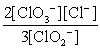
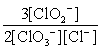
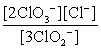
Write the mass-action expression, Qc , for the following chemical reaction. 3ClO2-(aq) Write the mass-action expression, Q<sub>c </sub>, for the following chemical reaction. 3ClO<sub>2</sub><sup>-</sup>(aq)    2ClO<sub>3</sub><sup>-</sup>(aq)  + Cl<sup>-</sup>(aq)  A)    B)    C)    D)    E)   2ClO3-(aq) + Cl-(aq)


A) Write the mass-action expression, Q<sub>c </sub>, for the following chemical reaction. 3ClO<sub>2</sub><sup>-</sup>(aq)    2ClO<sub>3</sub><sup>-</sup>(aq)  + Cl<sup>-</sup>(aq)  A)    B)    C)    D)    E)
B) Write the mass-action expression, Q<sub>c </sub>, for the following chemical reaction. 3ClO<sub>2</sub><sup>-</sup>(aq)    2ClO<sub>3</sub><sup>-</sup>(aq)  + Cl<sup>-</sup>(aq)  A)    B)    C)    D)    E)
C) Write the mass-action expression, Q<sub>c </sub>, for the following chemical reaction. 3ClO<sub>2</sub><sup>-</sup>(aq)    2ClO<sub>3</sub><sup>-</sup>(aq)  + Cl<sup>-</sup>(aq)  A)    B)    C)    D)    E)
D) Write the mass-action expression, Q<sub>c </sub>, for the following chemical reaction. 3ClO<sub>2</sub><sup>-</sup>(aq)    2ClO<sub>3</sub><sup>-</sup>(aq)  + Cl<sup>-</sup>(aq)  A)    B)    C)    D)    E)
E) Write the mass-action expression, Q<sub>c </sub>, for the following chemical reaction. 3ClO<sub>2</sub><sup>-</sup>(aq)    2ClO<sub>3</sub><sup>-</sup>(aq)  + Cl<sup>-</sup>(aq)  A)    B)    C)    D)    E)

F) A) and E)
G) A) and B)

Correct Answer

verifed

verified

Increasing the initial amount of the limiting reactant in a reaction will increase the value of the equilibrium constant, Kc.

A) True
B) False

Correct Answer

verifed

verified

Methanol can be synthesized by combining carbon monoxide and hydrogen. CO(g) + 2H2(g) Methanol can be synthesized by combining carbon monoxide and hydrogen. CO(g)  + 2H<sub>2</sub>(g)    CH<sub>3</sub>OH(g)  A reaction vessel contains the three gases at equilibrium with a total pressure of 1.00 atm. What will happen to the partial pressure of hydrogen if enough argon is added to raise the total pressure to 1.4 atm? A)  The partial pressure of hydrogen will decrease. B)  The partial pressure of hydrogen will increase. C)  The partial pressure of hydrogen will be unchanged. D)  K<sub>p</sub> needs to be known before a prediction can be made. E)  Both K<sub>p</sub> and the temperature need to be known before a prediction can be made. CH3OH(g) A reaction vessel contains the three gases at equilibrium with a total pressure of 1.00 atm. What will happen to the partial pressure of hydrogen if enough argon is added to raise the total pressure to 1.4 atm?


A) The partial pressure of hydrogen will decrease.
B) The partial pressure of hydrogen will increase.
C) The partial pressure of hydrogen will be unchanged.
D) Kp needs to be known before a prediction can be made.
E) Both Kp and the temperature need to be known before a prediction can be made.

F) A) and E)
G) B) and D)

Correct Answer

verifed

verified

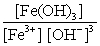
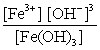
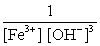
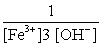
Write the mass-action expression, Qc , for the following chemical reaction. Fe3+(aq) + 3OH-(aq) Write the mass-action expression, Q<sub>c </sub>, for the following chemical reaction. Fe<sup>3+</sup>(aq)  + 3OH<sup>-</sup>(aq)    Fe(OH) <sub>3</sub>(s)  A)    B)    C)    D)    E)   Fe(OH) 3(s)


A) Write the mass-action expression, Q<sub>c </sub>, for the following chemical reaction. Fe<sup>3+</sup>(aq)  + 3OH<sup>-</sup>(aq)    Fe(OH) <sub>3</sub>(s)  A)    B)    C)    D)    E)
B) Write the mass-action expression, Q<sub>c </sub>, for the following chemical reaction. Fe<sup>3+</sup>(aq)  + 3OH<sup>-</sup>(aq)    Fe(OH) <sub>3</sub>(s)  A)    B)    C)    D)    E)
C) Write the mass-action expression, Q<sub>c </sub>, for the following chemical reaction. Fe<sup>3+</sup>(aq)  + 3OH<sup>-</sup>(aq)    Fe(OH) <sub>3</sub>(s)  A)    B)    C)    D)    E)
D) Write the mass-action expression, Q<sub>c </sub>, for the following chemical reaction. Fe<sup>3+</sup>(aq)  + 3OH<sup>-</sup>(aq)    Fe(OH) <sub>3</sub>(s)  A)    B)    C)    D)    E)
E) Write the mass-action expression, Q<sub>c </sub>, for the following chemical reaction. Fe<sup>3+</sup>(aq)  + 3OH<sup>-</sup>(aq)    Fe(OH) <sub>3</sub>(s)  A)    B)    C)    D)    E)

F) B) and D)
G) A) and E)

Correct Answer

verifed

verified

Consider the equilibrium H2(g) + Br2(g) Consider the equilibrium H<sub>2</sub>(g) + Br<sub>2</sub>(g)   2HBr(g) To a 20.0 L flask are added 0.100 moles of H<sub>2</sub> and 0.200 moles of HBr. The equilibrium constant for this reaction is 989. Calculate the number of moles of Br<sub>2</sub> in the flask when equilibrium is established. Make any reasonable approximation, clearly stating what that approximation is. 2HBr(g) To a 20.0 L flask are added 0.100 moles of H2 and 0.200 moles of HBr. The equilibrium constant for this reaction is 989. Calculate the number of moles of Br2 in the flask when equilibrium is established. Make any reasonable approximation, clearly stating what that approximation is.

Correct Answer

verifed

verified

~ 4.0 × 10⁻⁴ mol of Br2 present at...

View Answer

Unless rxn = 0, a change in temperature will affect the value of the equilibrium constant Kc.

A) True
B) False

Correct Answer

verifed

verified

Although a system may be at equilibrium, the rate constants of the forward and reverse reactions will in general be different.

A) True
B) False

Correct Answer

verifed

verified

True

At 850°C, the equilibrium constant Kp for the reaction C(s) + CO2(g) At 850°C, the equilibrium constant K<sub>p</sub> for the reaction C(s)  + CO<sub>2</sub>(g)    2CO(g)  Has a value of 10.7. If the total pressure in the system at equilibrium is 1.000 atm, what is the partial pressure of carbon monoxide? A)  0.362 atm B)  0.489 atm C)  0.667 atm D)  0.915 atm E)  0.921 atm 2CO(g) Has a value of 10.7. If the total pressure in the system at equilibrium is 1.000 atm, what is the partial pressure of carbon monoxide?


A) 0.362 atm
B) 0.489 atm
C) 0.667 atm
D) 0.915 atm
E) 0.921 atm

F) A) and E)
G) A) and D)

Correct Answer

verifed

verified

For some gas-phase reactions, Kp = Kc.

A) True
B) False

Correct Answer

verifed

verified

If all the reactants and products in an equilibrium reaction are in the gas phase, then Kp = Kc.

A) True
B) False

Correct Answer

verifed

verified

The following reaction is at equilibrium in a closed container. CuSO4.5H2O(s) The following reaction is at equilibrium in a closed container. CuSO<sub>4</sub>.5H<sub>2</sub>O(s)    CuSO<sub>4</sub>(s) <sub> </sub> + 5H<sub>2</sub>O(g)  Which, if any, of the following actions will lead to an increase in the pressure of H<sub>2</sub>O present at equilibrium? A)  increasing the volume of the container B)  decreasing the volume of the container C)  adding a catalyst D)  removing some solid CuSO<sub>4</sub> E)  none of the above CuSO4(s) + 5H2O(g) Which, if any, of the following actions will lead to an increase in the pressure of H2O present at equilibrium?


A) increasing the volume of the container
B) decreasing the volume of the container
C) adding a catalyst
D) removing some solid CuSO4
E) none of the above

F) A) and B)
G) C) and E)

Correct Answer

verifed

verified

At a high temperature, the following reaction has an equilibrium constant of 1.0 × 10². H2(g) + F2(g) At a high temperature, the following reaction has an equilibrium constant of 1.0 × 10<sup>2</sup>. H<sub>2</sub>(g) + F<sub>2</sub>(g)   2HF(g) If 1.00 mol of each of H<sub>2</sub> and F<sub>2</sub> are allowed to come to equilibrium in a 10.0 L vessel, calculate the equilibrium amounts of H<sub>2</sub> and HF. 2HF(g) If 1.00 mol of each of H2 and F2 are allowed to come to equilibrium in a 10.0 L vessel, calculate the equilibrium amounts of H2 and HF.

Correct Answer

verifed

verified

0.17 mol o...

View Answer

The two equilibrium constants for the same reaction, Kc and Kp, will always equal one another when


A) all of the reactants and products are gases.
B) in the reaction equation, the number of moles of gaseous products equals the number of moles of gaseous reactants.
C) in the reaction equation, the number of moles of gaseous products is greater than the number of moles of gaseous reactants.
D) in the reaction equation, the number of moles of gaseous products is smaller than the number of moles of gaseous reactants.
E) in the reaction equation, the total number of moles of reactants equals that of the products.

F) B) and E)
G) D) and E)

Correct Answer

verifed

verified

Consider the reversible reaction: 2NO2(g) Consider the reversible reaction: 2NO<sub>2</sub>(g)    N<sub>2</sub>O<sub>4</sub>(g)  If the concentrations of both NO<sub>2 </sub>and N<sub>2</sub>O<sub>4</sub> are 0.016 mol L<sup>-1</sup>, what is the value of Q<sub>c</sub>? A)  0.016 B)  0.50 C)  1.0 D)  2.0 E)  63 N2O4(g) If the concentrations of both NO2 and N2O4 are 0.016 mol L-1, what is the value of Qc?


A) 0.016
B) 0.50
C) 1.0
D) 2.0
E) 63

F) B) and D)
G) B) and C)

Correct Answer

verifed

verified

Consider the following two equilibria and their respective equilibrium constants: (1) NO(g) + Consider the following two equilibria and their respective equilibrium constants: (1)  NO(g)  +   O<sub>2</sub>(g)    NO<sub>2</sub>(g)  (2)  2NO<sub>2</sub>(g)    2NO(g)  + O<sub>2</sub>(g)  Which one of the following is the correct relationship between the equilibrium constants K<sub>1</sub> and K<sub>2</sub>? A)  K<sub>2</sub> = 2/K<sub>1</sub> B)  K<sub>2</sub> = (1/K<sub>1</sub>) <sup>2</sup> C)  K<sub>2 </sub>= -K<sub>1</sub>/2 D)  K<sub>2</sub> = 1/(2K<sub>1</sub>)  E)  K<sub>2</sub> = 1/(2K<sub>1</sub>) <sup>2</sup> O2(g) Consider the following two equilibria and their respective equilibrium constants: (1)  NO(g)  +   O<sub>2</sub>(g)    NO<sub>2</sub>(g)  (2)  2NO<sub>2</sub>(g)    2NO(g)  + O<sub>2</sub>(g)  Which one of the following is the correct relationship between the equilibrium constants K<sub>1</sub> and K<sub>2</sub>? A)  K<sub>2</sub> = 2/K<sub>1</sub> B)  K<sub>2</sub> = (1/K<sub>1</sub>) <sup>2</sup> C)  K<sub>2 </sub>= -K<sub>1</sub>/2 D)  K<sub>2</sub> = 1/(2K<sub>1</sub>)  E)  K<sub>2</sub> = 1/(2K<sub>1</sub>) <sup>2</sup> NO2(g) (2) 2NO2(g) Consider the following two equilibria and their respective equilibrium constants: (1)  NO(g)  +   O<sub>2</sub>(g)    NO<sub>2</sub>(g)  (2)  2NO<sub>2</sub>(g)    2NO(g)  + O<sub>2</sub>(g)  Which one of the following is the correct relationship between the equilibrium constants K<sub>1</sub> and K<sub>2</sub>? A)  K<sub>2</sub> = 2/K<sub>1</sub> B)  K<sub>2</sub> = (1/K<sub>1</sub>) <sup>2</sup> C)  K<sub>2 </sub>= -K<sub>1</sub>/2 D)  K<sub>2</sub> = 1/(2K<sub>1</sub>)  E)  K<sub>2</sub> = 1/(2K<sub>1</sub>) <sup>2</sup> 2NO(g) + O2(g) Which one of the following is the correct relationship between the equilibrium constants K1 and K2?


A) K2 = 2/K1
B) K2 = (1/K1) 2
C) K2 = -K1/2
D) K2 = 1/(2K1)
E) K2 = 1/(2K1) 2

F) A) and C)
G) B) and D)

Correct Answer

verifed

verified

A chemical reaction will reach equilibrium when the limiting reactant is used up.

A) True
B) False

Correct Answer

verifed

verified

False

In water, the following equilibrium exists: H+(aq) + OH-(aq) In water, the following equilibrium exists: H<sup>+</sup>(aq)  + OH<sup>-</sup>(aq)    <sub> </sub> H<sub>2</sub>O(l)  In pure water at 25 °C, the concentration of H<sup>+</sup> ions is 1.00 × 10<sup>-7</sup> mol/L. Calculate the value of the equilibrium constant for the reaction as written above. A)  1.00 × 10<sup>14</sup> B)  1.00 × 10<sup>12</sup> C)  1.00 × 10<sup>-14</sup> D)  1.00 × 10<sup>-12</sup> E)  5.55 × 10<sup>15</sup> H2O(l) In pure water at 25 °C, the concentration of H+ ions is 1.00 × 10⁻⁷ mol/L. Calculate the value of the equilibrium constant for the reaction as written above.


A) 1.00 × 10¹⁴
B) 1.00 × 10¹²
C) 1.00 × 10⁻¹⁴
D) 1.00 × 10⁻¹²
E) 5.55 × 10¹⁵

F) B) and E)
G) A) and B)

Correct Answer

verifed

verified

A

Hydrogen bromide will dissociate into hydrogen and bromine gases. 2HBr(g) Hydrogen bromide will dissociate into hydrogen and bromine gases. 2HBr(g)    H<sub>2</sub>(g)  + Br<sub>2</sub>(g)  <font face= symbol ></font>H°<sub>rxn</sub> = 68 kJ What effect will a temperature increase of 50°C have on this system at equilibrium? A)  The partial pressure of hydrogen bromide will increase. B)  The partial pressure of hydrogen will increase. C)  The partial pressure of hydrogen bromide and bromine will increase. D)  There will be no effect on the partial pressure of any of the gases. E)  Need to know the initial pressure, volume, and temperature before any of the above predictions can be made. H2(g) + Br2(g) rxn = 68 kJ What effect will a temperature increase of 50°C have on this system at equilibrium?


A) The partial pressure of hydrogen bromide will increase.
B) The partial pressure of hydrogen will increase.
C) The partial pressure of hydrogen bromide and bromine will increase.
D) There will be no effect on the partial pressure of any of the gases.
E) Need to know the initial pressure, volume, and temperature before any of the above predictions can be made.

F) A) and C)
G) C) and E)

Correct Answer

verifed

verified

About half of the sodium carbonate produced is used in making glass products because it lowers the melting point of sand, the major component of glass. When sodium carbonate is added to water it hydrolyses according to the following reactions. CO32-(aq) + H2O(l) About half of the sodium carbonate produced is used in making glass products because it lowers the melting point of sand, the major component of glass. When sodium carbonate is added to water it hydrolyses according to the following reactions. CO<sub>3</sub><sup>2-</sup>(aq)  + H<sub>2</sub>O(l)    HCO<sub>3</sub><sup>-</sup>(aq)  + OH<sup>-</sup>(aq)  K<sub>1</sub> <sub> </sub>HCO<sub>3</sub><sup>-</sup>(aq)  + H<sub>2</sub>O(l)    H<sub>2</sub>CO<sub>3</sub>(aq)  + OH<sup>-</sup>(aq)  K<sub>2</sub> These can be combined to yield CO<sub>3</sub><sup>2-</sup>(aq)  + 2H<sub>2</sub>O(l)    H<sub>2</sub>CO<sub>3</sub>(aq)  + 2OH<sup>-</sup>(aq)  K<sub>3</sub> What is the value of K<sub>3</sub>? A)  K<sub>1 </sub>× K<sub> 2</sub> B)  K<sub>1</sub> ÷ K<sub> 2</sub> C)  K<sub> 1 </sub>+ K<sub> 2</sub> D)  K<sub> 1 </sub>- K<sub> 2</sub> E)  (K<sub>1</sub>K<sub>2</sub>) <sup>2</sup> HCO3-(aq) + OH-(aq) K1 HCO3-(aq) + H2O(l) About half of the sodium carbonate produced is used in making glass products because it lowers the melting point of sand, the major component of glass. When sodium carbonate is added to water it hydrolyses according to the following reactions. CO<sub>3</sub><sup>2-</sup>(aq)  + H<sub>2</sub>O(l)    HCO<sub>3</sub><sup>-</sup>(aq)  + OH<sup>-</sup>(aq)  K<sub>1</sub> <sub> </sub>HCO<sub>3</sub><sup>-</sup>(aq)  + H<sub>2</sub>O(l)    H<sub>2</sub>CO<sub>3</sub>(aq)  + OH<sup>-</sup>(aq)  K<sub>2</sub> These can be combined to yield CO<sub>3</sub><sup>2-</sup>(aq)  + 2H<sub>2</sub>O(l)    H<sub>2</sub>CO<sub>3</sub>(aq)  + 2OH<sup>-</sup>(aq)  K<sub>3</sub> What is the value of K<sub>3</sub>? A)  K<sub>1 </sub>× K<sub> 2</sub> B)  K<sub>1</sub> ÷ K<sub> 2</sub> C)  K<sub> 1 </sub>+ K<sub> 2</sub> D)  K<sub> 1 </sub>- K<sub> 2</sub> E)  (K<sub>1</sub>K<sub>2</sub>) <sup>2</sup> H2CO3(aq) + OH-(aq) K2 These can be combined to yield CO32-(aq) + 2H2O(l) About half of the sodium carbonate produced is used in making glass products because it lowers the melting point of sand, the major component of glass. When sodium carbonate is added to water it hydrolyses according to the following reactions. CO<sub>3</sub><sup>2-</sup>(aq)  + H<sub>2</sub>O(l)    HCO<sub>3</sub><sup>-</sup>(aq)  + OH<sup>-</sup>(aq)  K<sub>1</sub> <sub> </sub>HCO<sub>3</sub><sup>-</sup>(aq)  + H<sub>2</sub>O(l)    H<sub>2</sub>CO<sub>3</sub>(aq)  + OH<sup>-</sup>(aq)  K<sub>2</sub> These can be combined to yield CO<sub>3</sub><sup>2-</sup>(aq)  + 2H<sub>2</sub>O(l)    H<sub>2</sub>CO<sub>3</sub>(aq)  + 2OH<sup>-</sup>(aq)  K<sub>3</sub> What is the value of K<sub>3</sub>? A)  K<sub>1 </sub>× K<sub> 2</sub> B)  K<sub>1</sub> ÷ K<sub> 2</sub> C)  K<sub> 1 </sub>+ K<sub> 2</sub> D)  K<sub> 1 </sub>- K<sub> 2</sub> E)  (K<sub>1</sub>K<sub>2</sub>) <sup>2</sup> H2CO3(aq) + 2OH-(aq) K3 What is the value of K3?


A) K1 × K 2
B) K1 ÷ K 2
C) K 1 + K 2
D) K 1 - K 2
E) (K1K2) 2

F) C) and D)
G) A) and E)

Correct Answer

verifed

verified

When a reaction system reaches equilibrium, the forward and reverse reactions stop.

A) True
B) False

Correct Answer

verifed

verified

Showing 1 - 20 of 104

Related Exams

Show Answer